
Home
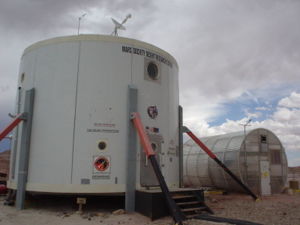
The Mars Desert Research Station (MDRS) is a Mars analog research facility run by The Mars Society in the southern Utah desert — the second of the Society's analog stations and one of the longest-running Mars surface simulations in the world. Since its habitat was built in 2001, rotating crews have lived "in simulation" near Hanksville, wearing analog spacesuits for surface excursions and rationing water, power, and communications much as an early Mars settlement would.
The campus has grown into a cluster of connected modules — the two-story Hab, the GreenHab greenhouse, the Science Dome laboratory, the RAM engineering workshop, and the Musk Mars Desert Observatory. Each field season (roughly October–May) hosts crews of six or seven scientists, engineers, and students from around the world; by 2025 more than 300 crews had completed rotations, carrying out research in geology, biology, engineering, and human factors. Read more →
Join the Marspedia Project — help us build the encyclopedia of Mars exploration and settlement!
New here?
Start with the Marspedia Tutorials and the help pages to learn how editing, formatting, and searching work.
Ways to help
- Request an account, then edit any page with Edit (VisualEditor) or Edit source.
- Expand an article stub or start one from the Needed Articles list.
- Tidy an article in the cleanup category.
- Join the Editorial or Technical subcommittee.
- Already wrote something? Submit your content and we'll add it for you.

Marspedia is an official project of The Mars Society and The Moon Society.
- Content Licenses
- Content on Marspedia is Public Domain unless otherwise noted.
- Articles that have specific content licenses will be tagged as such.
- Disclaimer: The content licenses used on Marspedia do not apply to other wikis in our Interwiki network.
Marspedia is organized as a Specific Hierarchy of Categories
The Editorial Subcommittee examined the past ad hoc approach of categorization of Marspedia articles and found it to be lacking a structure of how information about Mars is displayed and searched. The Subcommittee wanted a logical and navigable hierarchy of categories. This would also form the core of a new Browse experience. The new Marspedia category tree is much more focused on the future and specifically expanded on aspects of the future human exploration and permanent settlement of the Red Planet. It also focuses on outreach (advocacy) and the arts and literature to encourage individuals and the public at large to support human exploration and settlement there. Finally Marspedia is focused on providing the best source of information about past, present, and future exploration and settlement of Mars.
View Category:Main
Category Hierarchy
All categories for Marspedia roll up into the following 6 top-level categories. Two lower tiers of categories and pages linked to them can be seen by clicking the link icon on each. Creators of new pages should only link one or more of the categories in the hierarchy shown below to their page.
- I. Mars Planetary Science - physical description of the planet; all the science data that is collected
- II. Mars Spacecraft/Robotic Missions - (non-human) - mission planning and execution history.
- III. Mars Human Exploration - human exploration concepts and planning
- IV. Mars Human Settlement - including plans & concepts, philosophical/ethical considerations, and mars analogue research
- V. Mars Outreach - Advocacy for Mars Exploration/Settlement - people and organizations (Mars Society, Marspedia, etc), political action, and public outreach & education
- VI. Mars Arts and Literature - Mars in literature, music, movies, plays, graphic arts, photography