
Template:Featured Article: Difference between revisions
Featured Article: Mars Desert Research Station |
|||
| (35 intermediate revisions by 3 users not shown) | |||
| Line 1: | Line 1: | ||
[[File:mdrs.jpg|300px|left|Mars Desert Research Station|link=Mars Desert Research Station]] | |||
[[ | <div align="justify" style="text-align:justify;padding:0 5px;"> | ||
<div style="text-align: | The '''[[Mars Desert Research Station]]''' (MDRS) is a Mars analog research facility run by [[The Mars Society]] in the southern Utah desert — the second of the Society's analog stations and one of the longest-running Mars surface simulations in the world. Since its habitat was built in 2001, rotating crews have lived "in simulation" near Hanksville, wearing analog spacesuits for surface excursions and rationing water, power, and communications much as an early Mars settlement would. | ||
</div> | |||
</div><noinclude> | <div align="justify" style="text-align:justify;padding:0 5px;"> | ||
The campus has grown into a cluster of connected modules — the two-story Hab, the GreenHab greenhouse, the Science Dome laboratory, the RAM engineering workshop, and the Musk Mars Desert Observatory. Each field season (roughly October–May) hosts crews of six or seven scientists, engineers, and students from around the world; by 2025 more than 300 crews had completed rotations, carrying out research in geology, biology, engineering, and human factors. '''[[Mars Desert Research Station|Read more →]]''' | |||
</div> | |||
<noinclude> | |||
[[category:templates]][[category:Main Page Maintenance]] | [[category:templates]][[category:Main Page Maintenance]] | ||
</noinclude> | </noinclude> | ||
Latest revision as of 13:11, 5 July 2026
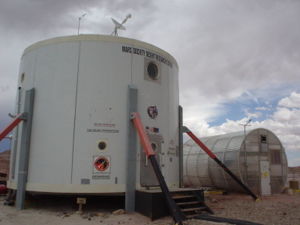
The Mars Desert Research Station (MDRS) is a Mars analog research facility run by The Mars Society in the southern Utah desert — the second of the Society's analog stations and one of the longest-running Mars surface simulations in the world. Since its habitat was built in 2001, rotating crews have lived "in simulation" near Hanksville, wearing analog spacesuits for surface excursions and rationing water, power, and communications much as an early Mars settlement would.
The campus has grown into a cluster of connected modules — the two-story Hab, the GreenHab greenhouse, the Science Dome laboratory, the RAM engineering workshop, and the Musk Mars Desert Observatory. Each field season (roughly October–May) hosts crews of six or seven scientists, engineers, and students from around the world; by 2025 more than 300 crews had completed rotations, carrying out research in geology, biology, engineering, and human factors. Read more →