
Zhurong: Difference between revisions
mNo edit summary |
added image |
||
| Line 1: | Line 1: | ||
Zhurong is a six-wheeled rover built by china. It landed on Mars in the area called Utopia Planitia on May 14, 2021. Zhurong is about the size of NASA's twin Mars rovers Spirit and Opportunity. It has six scientific instruments, including two panoramic cameras, a ground-penetrating radar and a magnetic field detector. Like America's Curiosity and Perseverance Martian rovers, Zhurong has a laser to zap rocks and thereby study their compositions.<ref>https://www.space.com/china-mars-rover-landing-success-tianwen-1-zhurong</ref> | Zhurong is a six-wheeled rover built by china. It landed on Mars in the area called Utopia Planitia on May 14, 2021. Zhurong is about the size of NASA's twin Mars rovers Spirit and Opportunity. It has six scientific instruments, including two panoramic cameras, a ground-penetrating radar and a magnetic field detector. Like America's Curiosity and Perseverance Martian rovers, Zhurong has a laser to zap rocks and thereby study their compositions.<ref>https://www.space.com/china-mars-rover-landing-success-tianwen-1-zhurong</ref> | ||
<gallery class="center" widths="380px" heights="360px"> | <gallery class="center" widths="380px" heights="360px"> | ||
File:ESP 070377 2050chinawide.jpg|Wide view of landscape near where Zhurong is exploring, as seen by HiRISE Scale bar at the top is 500 meters long. | |||
File:ESP 070377 2050china.jpg|Region near China's Rover, as seen by HiRISE | File:ESP 070377 2050china.jpg|Region near China's Rover, as seen by HiRISE | ||
Revision as of 14:59, 23 September 2021
Zhurong is a six-wheeled rover built by china. It landed on Mars in the area called Utopia Planitia on May 14, 2021. Zhurong is about the size of NASA's twin Mars rovers Spirit and Opportunity. It has six scientific instruments, including two panoramic cameras, a ground-penetrating radar and a magnetic field detector. Like America's Curiosity and Perseverance Martian rovers, Zhurong has a laser to zap rocks and thereby study their compositions.[1]
-
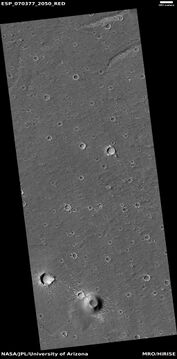 Wide view of landscape near where Zhurong is exploring, as seen by HiRISE Scale bar at the top is 500 meters long.
 -
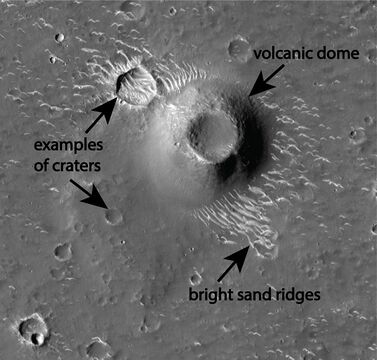 Region near China's Rover, as seen by HiRISE


References