
File:Martian Dust Devil Trails.jpg: Difference between revisions
This portion of a recent high-resolution picture from the HiRISE camera on board the Mars Reconnaissance Orbiter shows twisting dark trails criss-crossing light coloured terrain on the Martian surface. Newly formed trails like these had presented resea... |
m →Summary |
||
| Line 1: | Line 1: | ||
== Summary == | == Summary == | ||
This portion of a recent high-resolution picture from the HiRISE camera on board the Mars Reconnaissance Orbiter shows twisting dark trails criss-crossing light coloured terrain on the Martian surface. Newly formed trails like these had presented researchers with a tantalizing Martian mystery but are now known to be the work of miniature wind vortices known to occur on the red planet - Martian dust devils. Such spinning columns of rising air heated by the warm surface are also common in dry and desert areas on planet Earth. Typically lasting only a few minutes, dust devils becoming visible as they pick up loose red-coloured dust leaving the darker and heavier sand beneath intact. On Mars, dust devils can be up to 8 kilometres high. Dust devils have been credited with unexpected cleanings of Mars rover solar panels. | This portion of a recent high-resolution picture from the HiRISE camera on board the Mars Reconnaissance Orbiter shows twisting dark trails criss-crossing light coloured terrain on the Martian surface. Newly formed trails like these had presented researchers with a tantalizing Martian mystery but are now known to be the work of miniature wind vortices known to occur on the red planet - Martian dust devils. Such spinning columns of rising air heated by the warm surface are also common in dry and desert areas on planet Earth. Typically lasting only a few minutes, dust devils becoming visible as they pick up loose red-coloured dust leaving the darker and heavier sand beneath intact. On Mars, dust devils can be up to 8 kilometres high. Dust devils have been credited with unexpected cleanings of Mars rover solar panels. Dark slope streaks are visible along steep slopes of sand dunes. | ||
Source: http://www.uahirise.org/media/usage.php | Source: http://www.uahirise.org/media/usage.php | ||
Image credit: NASA/JPL/University of Arizona | Image credit: NASA/JPL/University of Arizona | ||
== Licensing == | == Licensing == | ||
{{PD}} | {{PD}} | ||


Latest revision as of 01:59, 29 May 2018
Summary
This portion of a recent high-resolution picture from the HiRISE camera on board the Mars Reconnaissance Orbiter shows twisting dark trails criss-crossing light coloured terrain on the Martian surface. Newly formed trails like these had presented researchers with a tantalizing Martian mystery but are now known to be the work of miniature wind vortices known to occur on the red planet - Martian dust devils. Such spinning columns of rising air heated by the warm surface are also common in dry and desert areas on planet Earth. Typically lasting only a few minutes, dust devils becoming visible as they pick up loose red-coloured dust leaving the darker and heavier sand beneath intact. On Mars, dust devils can be up to 8 kilometres high. Dust devils have been credited with unexpected cleanings of Mars rover solar panels. Dark slope streaks are visible along steep slopes of sand dunes.
Source: http://www.uahirise.org/media/usage.php Image credit: NASA/JPL/University of Arizona
Licensing
Public domain images are available for anybody to use without any licenses, royalties, or special permissions.
File history
Click on a date/time to view the file as it appeared at that time.
| Date/Time | Thumbnail | Dimensions | User | Comment | |
|---|---|---|---|---|---|
| current | 01:58, 29 May 2018 | 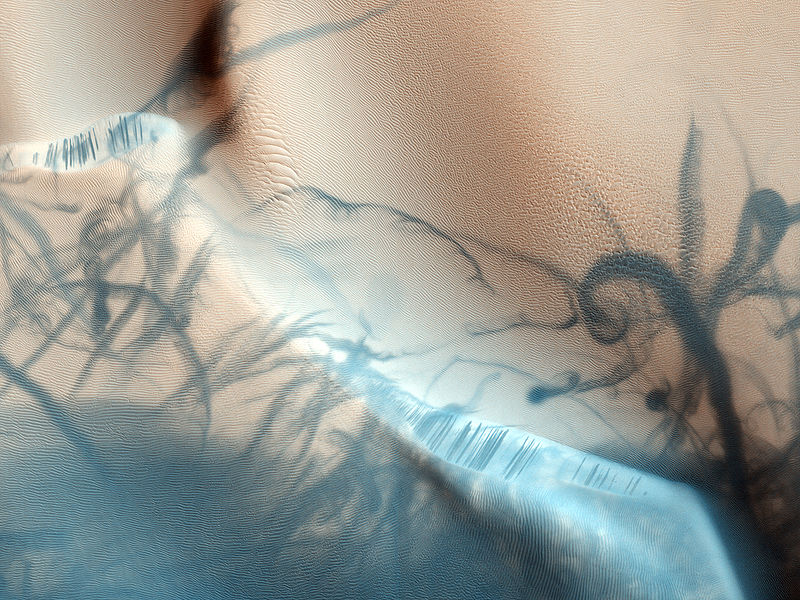 | 800 × 600 (147 KB) | Suitupandshowup (talk | contribs) | This portion of a recent high-resolution picture from the HiRISE camera on board the Mars Reconnaissance Orbiter shows twisting dark trails criss-crossing light coloured terrain on the Martian surface. Newly formed trails like these had presented resea... |
You cannot overwrite this file.
File usage
The following page uses this file:
