Difference between revisions of "Syrtis Major quadrangle"
Suitupshowup (talk | contribs) m |
Suitupshowup (talk | contribs) (→Linear Ridge Networks: added new section about discoveries in jezero) |
||
| Line 81: | Line 81: | ||
[[File:ESP 046403 2095dikecropped.jpg|thumb|500px|center|Dike]] | [[File:ESP 046403 2095dikecropped.jpg|thumb|500px|center|Dike]] | ||
| + | |||
| + | |||
| + | ==Jezero Crater discoveries with Perseverance== | ||
| + | |||
| + | The Perseverance rover has greatly increased our understanding of the crater. The processes that went on with Jezero may have gone on in many other Martian craters.Although Jezero shows the classic signs of a lake, especially with its deltas, igneous rocks were found.<ref> https://www.hou.usra.edu/meetings/lpsc2022/pdf/1530.pdf</ref> <ref>Schmidt, M., et al. 2022. HIGHLY DIFFERENTIATED BASALTIC LAVAS EXAMINED BY PIXL IN JEZERO CRATER. 53rd Lunar and Planetary Science Conference. 1530.pdf</ref> One would have expected just sedimentary rocks. Furthermore some of the rocks had large crystals that indicated slow cooling. Large crystals are formed in maga bodies after a long period of cooling. The crystals were composed of the mineral olivine surrounded by another mineral called pyroxene. That arrangement happens in thick magma bodies and geologists call this type of texture "Cumulate."<ref> https://www.bbc.com/news/science-environment-59677383</ref> In additon basalt lava was found.<ref> https://mars.nasa.gov/news/9036/nasas-perseverance-rover-collects-puzzle-pieces-of-mars-history/</ref> Minerals that are produced with water, like carbonates, were found as well. <ref>https://www.jpl.nasa.gov/news/nasas-perseverance-mars-rover-ready-to-roll-for-miles-in-years-ahead/?utm_source=iContact&utm_medium=email&utm_campaign=1-nasajpl&utm_content=daily20251218-3</ref> <ref>https://www.science.org/doi/10.1126/science.adu8264</ref> <ref>Kenneth H. Williford et al. ,Carbonated ultramafic igneous rocks in Jezero crater, Mars.Science0,eadu8264DOI:10.1126/science.adu8264</ref> | ||
| + | |||
| + | So at this point researchers have pieced together an understanding of the processes and their timing of how Jezero ended it to be how it is<ref>https://www.jpl.nasa.gov/news/nasas-perseverance-mars-rover-ready-to-roll-for-miles-in-years-ahead/?utm_source=iContact&utm_medium=email&utm_campaign=1-nasajpl&utm_content=daily20251218-3</ref> <ref>https://www.science.org/doi/10.1126/science.adu8264</ref> <ref>Kenneth H. Williford et al. ,Carbonated ultramafic igneous rocks in Jezero crater, Mars.Science0,eadu8264DOI:10.1126/science.adu8264</ref>. After an impact created the Jezero Crater cavity, hot magma moved into weak parts of the crust and accumulated under the ground forming what are called intrusions. They may be called sills, dikes, or lacoliths depending on their shapes. In these chambers, magma underwent a slow cooling. The rocks with the large crystals were part of a group that was named the Seith Formation. Lava, then came into Jezero. The basalt from the lava flow was called the Maaza Formation.<ref>https://www.bbc.com/news/science-environment-59677383</ref> <ref>https://www.jpl.nasa.gov/news/nasas-perseverance-mars-rover-makes-surprising-discoveries</ref> Maaz is rich in the minerals pyroxene and plagioclase. It cooled quicker on the top of a mass of magma or lava. Water has altered the chemistry of the rock because carbonate, iron oxides, amorphous silicates, sulfates, halite, perchlorates, phosphates, and possible | ||
| + | phyllosilicates were found in the rock.<ref> https://www.hou.usra.edu/meetings/lpsc2022/pdf/1798.pdf</ref> <ref>Sun, V., et al. 2022. EXPLORING THE JEZERO CRATER FLOOR: OVERVIEW OF RESULTS FROM THE MARS 2020</ref> Erosion removed some of the upper parts of the intrusions, especially the Seith Formation. As a result of this erosion, instruments on Perseverance were able to analyze the minerals in Seith and discover the size and composition of its minerals. Eventually a large lake developed in the crater and made the carbonate minerals found by instruments on Perseverance.<ref>https://www.jpl.nasa.gov/news/nasas-perseverance-mars-rover-ready-to-roll-for-miles-in-years-ahead/?utm_source=iContact&utm_medium=email&utm_campaign=1-nasajpl&utm_content=daily20251218-3</ref> <ref>https://www.science.org/doi/10.1126/science.adu8264</ref> <ref>Kenneth H. Williford et al. ,Carbonated ultramafic igneous rocks in Jezero crater, Mars.Science0,eadu8264DOI:10.1126/science.adu8264</ref> <ref> https://www.science.org/doi/10.1126/science.abo2196</ref> <ref>Farley, K., et al. 2022. Aqueously altered igneous rocks sampled on the floor of Jezero crater, Mars. Science. DOI: 10.1126/science.abo2196</ref> | ||
| + | |||
| + | Organic minerals that are probably aromatics or stable molecules of carbon and hydrogen connected to sulfates, were detected. Sulfate minerals can preserve information about the watery environments in which they formed. These molecules were found in a place called "Wildcat Ridge." It is believed to have formed as mud and sand settled in a saltwater lake that was evaporating. The Scanning Habitable Environments with Raman & Luminescence for Organics & Chemicals, or SHERLOC was used for the analysis.<ref>https://www.cnn.com/2022/09/15/world/perseverance-rover-mars-images-scn/index.html</ref> <ref>https://www.jpl.nasa.gov/news/nasas-perseverance-rover-investigates-geologically-rich-mars-terrain?utm_source=iContact&utm_medium=email&utm_campaign=nasajpl&utm_content=Daily-09152022</ref> | ||
| + | |||
| + | Some rock and mineral fragments that are present in the Skinner Ridge sample hint at originating hundreds of miles outside Jezero Crater. This is from a distance that the rover will not be able to travel, but scientists will still get to examine them when the samples are returned to Earth.<ref>https://www.msn.com/en-us/news/technology/perseverance-rover-finds-organic-matter-treasure-on-mars/ar-AA11SJvX?ocid=mailsignout&cvid=d57c0d217b88485f8e8e25525f1a15ef</ref> | ||
| + | |||
| + | Perseverance may have discovered the remains of life. It found chemicals that may have been created by anaerobic organisms in the past. Speckles in rocks contained the minerals vivianite, an iron phosphate, and greigite, an iron sulfide. What’s more both formed in close association with organic carbon. On Earth, vivianite frequently forms in lakes and coastal sediments where microbes use iron in their metabolism. They take iron (III) oxide, use it, and then give off Ferrous iron (II) as a waste. That ferrous iron reacts with phosphate to form vivianite.<ref> https://www.sciencedirect.com/science/article/abs/pii/S0048969720366067#:~:text=Vivianite%20is%20an%20important%20product,of%20vivianite%20in%20environmental%20field.</ref> <ref>Yuan, Q., et al. 2021. Biosynthesis of vivianite from microbial extracellular electron transfer and environmental application. Science of the total environment. Volume 762, 143076 </ref> | ||
| + | Greigite tends to form when microbes break down sulfate. They change sulfate to sulfide which unites with iron to produce greigite. <ref>Igarashi, K., et al. 2016. Natural synthesis of bioactive greigite by solid–gas reactions. journal/geochimica-et-cosmochimica-acta . Volume 191, 15 October 2016, Pages 47-57. </ref> When found together on Earth, these minerals and organic molecules are usually considered a sort of biosignature.<ref>https://www.scientificamerican.com/article/is-there-life-on-mars-this-rock-may-hold-the-answer/#:~:text=In%20their%20Nature%20study%2C%20Hurowitz,also%20shows%20an%20abrasion%20patch.</ref> <ref>https://www.scientificamerican.com/article/is-there-life-on-mars-this-rock-may-hold-the-answer/#:~:text=In%20their%20Nature%20study%2C%20Hurowitz,also%20shows%20an%20abrasion%20patch.</ref> There are possible, but not probable ways, that these minerals may have been formed without microbes.<ref> Hurowitz, J.A., Tice, M.M., Allwood, A.C. et al. Redox-driven mineral and organic associations in Jezero Crater, Mars. Nature 645, 332–340 (2025). https://doi.org/10.1038/s41586-025-09413-0</ref> They could have been made without biological reactions, including constant high temperatures, acidic conditions, and binding by organic compounds. But, the rocks in this place, called Bright Angel, do not show evidence that they experienced high temperatures or acidic conditions, and it is unknown whether the organic compounds present would’ve been capable of catalyzing the reaction at the expected low temperatures. This chemical evidence of past life appeared in some of the youngest sedimentary rocks the mission has examined. For a long time, we assumed signs of ancient life would be only found in older rock formations. This discovery may mean that Mars could have been habitable for a longer period or later in the planet’s history than previously thought. Older rocks also might hold signs of life that are simply harder to detect.<ref> https://www.nasa.gov/news-release/nasa-says-mars-rover-discovered-potential-biosignature-last-year/#:~:text=In%20higher%2Dresolution%20images%2C%20the,the%20reaction%20at%20low%20temperatures.</ref> The truth about these rocks may not be really known until the samples that were gathered are brought to the Earth. | ||
==Linear Ridge Networks== | ==Linear Ridge Networks== | ||
Latest revision as of 10:03, 12 January 2026

| MC-13 | Syrtis Major | 0–30° N | 45–90° E | Quadrangles | Atlas |

Typical features of Syrtis Major quadrangle


In this article, some of the best pictures from a number of spacecraft will show what the landscape looks like in this quadrangle. The origins and significance of all features will be explained as they are currently understood.
The Syrtis Major quadrangle covers latitudes 0° to 30° N and longitudes 270° to 315° W (45-90 E). Syrtis Major quadrangle includes some other named regions: Syrtis Major Planum, and parts of Terra Sabaea and Isidis Planitia.[1]
Geologically, Syrtis Major is an ancient shield volcano with a central depression that is elongated in a north-south direction. Calderas are large openings at the top of volcanoes. Syrtis Major contains the calderas named Meroe Patera and Nili Patera.[2] Other geologically interesting features in the area include dikes and inverted terrain. The eastern part of the Quadrangle is the Isidris Planitia impact crater. The Beagle 2 lander crashed in this quadrangle in December 2003. In January 2015, NASA reported that they had found it in Isidis Planitia (location is about 11.5265 N and 90.4295 E.[3] [4] [5] It was imaged by HiRISE onboard the Mars Reconnaissance Orbiter. Beagle 2 looked intact.[6] [7] [8] In November 2018, NASA announced that Jezero Crater was chosen as the landing site for the planned Mars 2020 mission.[9] Jezero Crater is located at 18.855 N and 77.519 E[10]
Perseverance was the name picked for the rover; it landed right on target near the delta on February 18, 2021.[11]
Contents
Jezero Crater

Delta in Jezero Crater
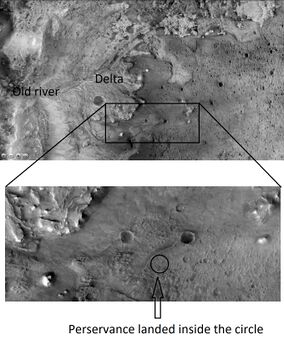
Landing site for Perseverance Rover
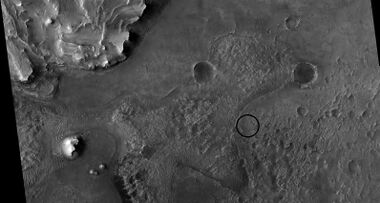
Another view of landing site
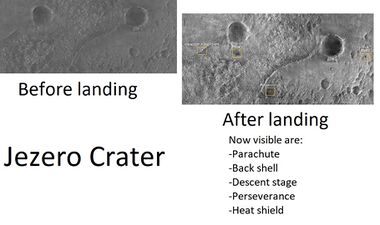
Before and after views of landing site, as seen from orbit with HiRISE


Features in Jezero Crater near delta
How named
Syrtis Major is named after the classical Roman name Syrtis maior for the Gulf of Sidra that is found on the coast of Libya (classical Cyrenaica). Interestingly, Syrtis Major is near Cyrene which accoding to the Bilbe is the place where "Simon" who carried the cross of Jesus was from.[12] [13] [14]
Discovery and history
Syrtis Major is the main marking that people see when they look at Mars through a backyard telescope. It was discovered by Christiaan Huygens, who included it in a drawing of Mars in 1659. It was originally known as the "Hourglass Sea.” Different cartographers have given it different names over centuries. Johann Heinrich von Mädler in 1840 called the feature “Atlantic Canale.” Richard Proctor called it “Kaiser Sea” in 1867. A little later, Camille Flammarion called it the “Mer du Sablier” (French for "Hourglass Sea") when he updated Proctor's naming system in 1876. Syrtis Major, the name that has stuck was picked by Giovanni Schiaparelli when he created a map based on observations made during Mars' close approach to Earth in 1877.[15] [16]
Igneous rocks
The Syrtis Major region is of great interest to geologists since several types of igneous rocks have been found there with orbiting spacecraft. Besides basalt, dacite and granite have been found there. Dacite originates under volcanoes in magma chambers. In magma chambers new minerals and rocks are put together. After heavy minerals (olivine and pyroxene) containing iron and magnesium have settled to the bottom, Dacites form at the top of the chamber. Granite is formed by an even more complex process.[17] Some areas of Syrtis Major contain large amounts of the mineral olivine. Olivine turns into other minerals very rapidly in the presence of water, so if we find olivine, we know that the place has been dry for a long time.[18]
Minerals
A variety of important minerals have been discovered near Nili Fossae, a major trough system in Syrtis Major. Besides olivine, other minerals found there include carbonates, aluminum smectite, iron/magnesium smectite, hydrated silica, kaolinite group minerals, and iron oxides.[19] [20] In December 2008, NASA's Mars Reconnaissance Orbiter found carbonate minerals, a geologically significant discovery.[21] [22][23] Later research published in October 2010, described a large deposit of carbonate rocks found inside Leighton Crater. The rocks at one time were buried 4 miles below the surface.
This discovery has great importance in understanding the history of the planet. Finding carbonates in an underground location means that Mars may have been warmer and may have had atmospheric carbon dioxide and ancient seas. Because the carbonates were found near silicate minerals and clays, hydrothermal systems like the deep sea vents on Earth may have been present.[24] [25]
Other minerals found by the Mars Reconnaissance Orbiter are aluminum smectite, iron/magnesium smectite, hydrated silica, kaolinite group minerals, iron oxides, and talc.[26] [27]
NASA scientists have also discovered that Nili Fossae is the source of plumes of methane, raising the question of whether this source originates from biological sources.[28] [29]
Dikes
Narrow ridges occur in some places on Mars. They may be formed by different means, but some are probably caused by molten rock moving underground and moving along cracks or faults in the rock. When they cool, walls of hard rock may be formed after being exposed by the erosion of softer, surrounding materials. Such a feature is termed a dike. They are common on Earth—a famous one is Shiprock, New Mexico.[30] [31]

Dikes near Shiprock, New Mexico

Mapping the presence of dikes allows us to understand how magma (molten rock under the ground) travels and where it could have interacted with surrounding rock, thus producing valuable ores. Deposits of important minerals are also made by dikes and other types of magma movements. These superhot liquid rocks heat water. The hot water dissolves minerals that are deposited in cracks in nearby rock. This process involving hot water has given us many sources of important minerals.[32] One would expect a great deal of intrusive igneous activity (molten rock under the ground) to occur on Mars. It is accepted that there is more igneous activity under the ground than on top. More molten rock moves underground than what formed volcanoes. In other words, more liquid rock was under the surface than in the many massive Martian volcanoes.[33]

Jezero Crater discoveries with Perseverance
The Perseverance rover has greatly increased our understanding of the crater. The processes that went on with Jezero may have gone on in many other Martian craters.Although Jezero shows the classic signs of a lake, especially with its deltas, igneous rocks were found.[34] [35] One would have expected just sedimentary rocks. Furthermore some of the rocks had large crystals that indicated slow cooling. Large crystals are formed in maga bodies after a long period of cooling. The crystals were composed of the mineral olivine surrounded by another mineral called pyroxene. That arrangement happens in thick magma bodies and geologists call this type of texture "Cumulate."[36] In additon basalt lava was found.[37] Minerals that are produced with water, like carbonates, were found as well. [38] [39] [40]
So at this point researchers have pieced together an understanding of the processes and their timing of how Jezero ended it to be how it is[41] [42] [43]. After an impact created the Jezero Crater cavity, hot magma moved into weak parts of the crust and accumulated under the ground forming what are called intrusions. They may be called sills, dikes, or lacoliths depending on their shapes. In these chambers, magma underwent a slow cooling. The rocks with the large crystals were part of a group that was named the Seith Formation. Lava, then came into Jezero. The basalt from the lava flow was called the Maaza Formation.[44] [45] Maaz is rich in the minerals pyroxene and plagioclase. It cooled quicker on the top of a mass of magma or lava. Water has altered the chemistry of the rock because carbonate, iron oxides, amorphous silicates, sulfates, halite, perchlorates, phosphates, and possible phyllosilicates were found in the rock.[46] [47] Erosion removed some of the upper parts of the intrusions, especially the Seith Formation. As a result of this erosion, instruments on Perseverance were able to analyze the minerals in Seith and discover the size and composition of its minerals. Eventually a large lake developed in the crater and made the carbonate minerals found by instruments on Perseverance.[48] [49] [50] [51] [52]
Organic minerals that are probably aromatics or stable molecules of carbon and hydrogen connected to sulfates, were detected. Sulfate minerals can preserve information about the watery environments in which they formed. These molecules were found in a place called "Wildcat Ridge." It is believed to have formed as mud and sand settled in a saltwater lake that was evaporating. The Scanning Habitable Environments with Raman & Luminescence for Organics & Chemicals, or SHERLOC was used for the analysis.[53] [54]
Some rock and mineral fragments that are present in the Skinner Ridge sample hint at originating hundreds of miles outside Jezero Crater. This is from a distance that the rover will not be able to travel, but scientists will still get to examine them when the samples are returned to Earth.[55]
Perseverance may have discovered the remains of life. It found chemicals that may have been created by anaerobic organisms in the past. Speckles in rocks contained the minerals vivianite, an iron phosphate, and greigite, an iron sulfide. What’s more both formed in close association with organic carbon. On Earth, vivianite frequently forms in lakes and coastal sediments where microbes use iron in their metabolism. They take iron (III) oxide, use it, and then give off Ferrous iron (II) as a waste. That ferrous iron reacts with phosphate to form vivianite.[56] [57] Greigite tends to form when microbes break down sulfate. They change sulfate to sulfide which unites with iron to produce greigite. [58] When found together on Earth, these minerals and organic molecules are usually considered a sort of biosignature.[59] [60] There are possible, but not probable ways, that these minerals may have been formed without microbes.[61] They could have been made without biological reactions, including constant high temperatures, acidic conditions, and binding by organic compounds. But, the rocks in this place, called Bright Angel, do not show evidence that they experienced high temperatures or acidic conditions, and it is unknown whether the organic compounds present would’ve been capable of catalyzing the reaction at the expected low temperatures. This chemical evidence of past life appeared in some of the youngest sedimentary rocks the mission has examined. For a long time, we assumed signs of ancient life would be only found in older rock formations. This discovery may mean that Mars could have been habitable for a longer period or later in the planet’s history than previously thought. Older rocks also might hold signs of life that are simply harder to detect.[62] The truth about these rocks may not be really known until the samples that were gathered are brought to the Earth.
Linear Ridge Networks

Some crater floors in the Syrtis Major area show elongated ridges arranged in a complex pattern.[63] Scientists are still debating over the exact origin of these features. Some have suggested that they are dikes made up of molten rock; others have advanced the idea that other fluids such as water were involved.[64] The ridges are found where there has been erosion.[65]


Wide view of ridges, as seen by HiRISE under HiWish program The colored strip is about 1 km across.

Close view of ridges, as seen by HiRISE under HiWish program

Close view of ridges, as seen by HiRISE under HiWish program Cracks are also visible. Picture is about 1 km across.


Dunes
Sand dunes are found all over Mars, especially in low spots like craters and the floors of old river valleys. Dunes in valleys on Mars usually lie at right angles to the valley walls.

Streaks
Astronomers have watched the surface of Mars change. For a long time, astronomers observing regular changes on Mars when the seasons changed, thought that what they were seeing was evidence of vegetation growing. Close inspection with a number of spacecraft, revealed other possibilities. We came to understand that changes are caused by the effects of the wind blowing dust around. Sometimes, fine bright dust settles on the dark basalt rock making the surface appear lighter, at other times the light-toned dust will be blown away; thus making the surface darken—just as if vegetation were growing. Mars has frequent regional or global dust storms that coat the surface with fine bright dust.
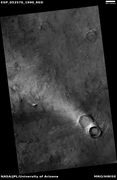
Light-toned streak on the lee ward side of a crater, as seen by HiRISE under HiWish program Here the crater rim diverted wind and kept it from removing bright dust.

Inverted relief
Some places on Mars show inverted relief. In these locations, a stream bed may be a raised feature, instead of a valley. Inverted former stream channels may be caused by the deposition of large rocks, cementation, or maybe by lava moving down the channel. In either case later erosion would erode the surrounding land and leave the old channel as a raised ridge because the ridge would be more resistant to erosion. The image below, taken with HiRISE show curved ridges that are old channels that have become inverted. They have the shape of streams but are above ground.[66]

Layers
Many places on Mars show rocks arranged in layers. Rock can form layers in a variety of ways. Volcanoes, wind, or water can produce layers.[67] Many layers on Mars are due to frequent large changes in the rotational axis that cause the climate to undergo drastic changes. Mars experiences such tilt variations because it lacks a large moon to stabilize its tilt.[68] [69] A detailed discussion of layering with many Martian examples can be found in Sedimentary Geology of Mars.[70]
Channels
There is enormous evidence that water once flowed in river valleys on Mars.[71] [72] Images of curved channels have been seen in images from Mars spacecraft dating back to the early seventies with the Mariner 9 orbiter.[73][74] [75] [76] One study, published in June 2017, calculated that the volume of water needed to carve all the channels on Mars was even larger than the proposed ocean that the planet may have had. Water was probably recycled many times as rainfall/snowfall from that Martian ocean.[77] [78]
Pictures below shown some of the many channels that have been observed on the Red Planet.

Channel, as seen by HiRISE under HiWish program

Channel


Hollows


Ground with hollowed out spots is common in some places on Mars. Sometimes giant hollows are formed. In other places, like the ones shown here, the hollows are of more modest size. Since much of the ground on Mars is ice-rich, when ice leaves high and low spots appear. Ice leaves the ground today on Mars by the process of sublimation. Ice changes directly to a gas and goes into the atmosphere.

Hollows that formed in crater floor deposit, as seen by HiRISE under HiWish program

Eroding mesa in Syrtis Major. It would be rough to walk across this feature. Image was taken with Mars Global Surveyor, under the MOC Public Targeting Program.


See Also
- Dust devils
- High Resolution Imaging Science Experiment (HiRISE)
- HiWish program
- How are features on Mars Named?
- Jezero Crater
- Layers on Mars
- Mars Global Surveyor
- Mars Perseverance Rover
- Mars volcanoes
- Periodic climate changes on Mars
- Rivers on Mars
- Sublimation
- Sublimation landscapes on Mars
- Water
External links
References
- ↑ Davies, M.E.; Batson, R.M.; Wu, S.S.C. "Geodesy and Cartography" in Kieffer, H.H.; Jakosky, B.M.; Snyder, C.W.; Matthews, M.S., Eds. Mars. University of Arizona Press: Tucson, 1992.
- ↑ http://www.daviddarling.info/encyclopedia/S/SyrtisMajor.html
- ↑ Ellison, Doug (16 January 2015). "re Beagle 2 location on Mars => "Using HiView on image ESP_039308_1915_COLOR.JP2 I get 90.4295E 11.5265N"". Twitter & JPL.
- ↑ Grecicius, Tony; Dunbar, Brian (16 January 2015). "Components of Beagle 2 Flight System on Mars". NASA. https://twitter.com/doug_ellison/status/556201983443357696 |
- ↑ ="NASA-20150116-TG" Grecicius |first1=Tony |last2=Dunbar |first2=Brian |title=Components of Beagle 2 Flight System on Mars |url=http://www.nasa.gov/jpl/mars/pia19106/ |date=16 January 2015
- ↑ name="NASA-20150116" Webster |first=Guy |title='Lost' 2003 Mars Lander Found by Mars Reconnaissance Orbiter |url=http://www.nasa.gov/jpl/lost-2003-mars-lander-found-by-mars-reconnaissance-orbiter/ |date=16 January 2015 |work=NASA |
- ↑ https://www.nytimes.com/2015/01/17/science/space/missing-lander-beagle-2-finally-located-on-mars.html |date=16 January 2015 |work=New York Times
- ↑ Amos |first=Jonathan |title=Lost Beagle2 probe found 'intact' on Mars |url=https://www.bbc.co.uk/news/science-environment-30784886 |date=16 January 2015
- ↑ "SPC-20181119">Wall |first=Mike |title=Jezero Crater or Bust! NASA Picks Landing Site for Mars 2020 Rover |url=https://www.space.com/42486-mars-2020-rover-jezero-crater-landing-site.html |date=19 November 2018 |work=Space.com |
- ↑ Wray, James (6 June 2008). "Channel into Jezero Crater Delta". NASA.
- ↑ https://mars.nasa.gov/news/8865/touchdown-nasas-mars-perseverance-rover-safely-lands-on-red-planet/
- ↑ https://ferrelljenkins.wordpress.com/2011/03/30/libya-and-the-bible-%E2%80%94-more-than-you-think/
- ↑ https://books.google.com/books?id=3JNQAQAAMAAJ&pg=PA18 The Cambridge Bible for Schools and Colleges, Volume 59
- ↑ Gleig, G. and T. Stackhouse. A History of the holy Bible, corrected and improved. https://books.google.com/books?id=jVIOAAAAQAAJ&pg=PA286
- ↑ Mapping Mars: Science, Imagination, and the Birth of a World| first=Oliver| last=Morton| publisher=Picador USA| location=New York| date=2002| isbn=0-312-24551-3| pages=14–15|
- ↑ http://www.uapress.arizona.edu/onlinebks/mars/chap04.htm%7Ctitle=The Planet Mars: A History of Observation and Discovery - Chapter 4: Areographers|author=William Sheehan|
- ↑ Christensen, P. 2005. "The Many Faces of Mars". Scientific American. July, 2005.
- ↑ http://www.marsdaily.com/news-odyssey-05a.html
- ↑ http://news.bbc.co.uk/2/hi/science/nature/7791060.stm "Nasa finds 'missing' Mars mineral"
- ↑ Murchie, S. et al. 2009. "A synthesis of Martian aqueous mineralogy after 1 Mars year of observations from the Mars Reconnaissance Orbiter". Journal of Geophysical Research: 114. E00D06.
- ↑ http://news.bbc.co.uk/2/hi/science/nature/7791060.stm NASA finds 'missing' Mars mineral
- ↑ http://www.space.com/30746-mars-missing-atmosphere-lost-in-space.html
- ↑ Edwards, C., B. Ehlmann. 2015. "Carbon sequestration on Mars". Geology: doi: 10.1130/G36983.1.
- ↑ http://www.astrobio.net/pressrelease/3646/exposed-rocks-point-to water-on-ancient-mars
- ↑ 1.Adrian J. Brown, Simon J. Hook, Alice M. Baldridge, James K. Crowley, Nathan T. Bridges, Bradley J. Thomson, Giles M. Marion, Carlos R. de Souza Filho, Janice L. Bishop. "Hydrothermal formation of Clay-Carbonate alteration assemblages in the Nili Fossae region of Mars". Earth and Planetary Science Letters, 2010;
- ↑ Murchie, S. et al. 2009. "A synthesis of Martian aqueous mineralogy after 1 Mars year of observations from the Mars Reconnaissance Orbiter". Journal of Geophysical Research: 114. E00D06.
- ↑ Adrian J. Brown, Simon J. Hook, Alice M. Baldridge, James K. Crowley, Nathan T. Bridges, Bradley J. Thomson, Giles M. Marion, Carlos R. de Souza Filho, Janice L. Bishop. "Hydrothermal formation of Clay-Carbonate alteration assemblages in the Nili Fossae region of Mars". Earth and Planetary Science Letters, 2010;
- ↑ http://dsc.discovery.com/news/2009/01/15/mars-methane-life.html Mars Methane Found, Raising Possibility of Life
- ↑ http://news.bbc.co.uk/2/hi/science/nature/7829315.stm New light on Mars methane mystery
- ↑ http://www.msss.com/mars_images/moc/2005/10/13/
- ↑ isbn = 0-87842-105-X|title = Roadside Geology of Colorado|last1 = Chronic|first1 = Halka|date = January 1980
- ↑ Namowitz, S. and D. Stone. 1975. Earth Science-The World We Live In. American Book Company. Ny, NY
- ↑ Crisp, J. 1984. "Rates of magma emplacement and volcanic output". J. Volcanlo. Geotherm. Res: 20. 177-211.
- ↑ https://www.hou.usra.edu/meetings/lpsc2022/pdf/1530.pdf
- ↑ Schmidt, M., et al. 2022. HIGHLY DIFFERENTIATED BASALTIC LAVAS EXAMINED BY PIXL IN JEZERO CRATER. 53rd Lunar and Planetary Science Conference. 1530.pdf
- ↑ https://www.bbc.com/news/science-environment-59677383
- ↑ https://mars.nasa.gov/news/9036/nasas-perseverance-rover-collects-puzzle-pieces-of-mars-history/
- ↑ https://www.jpl.nasa.gov/news/nasas-perseverance-mars-rover-ready-to-roll-for-miles-in-years-ahead/?utm_source=iContact&utm_medium=email&utm_campaign=1-nasajpl&utm_content=daily20251218-3
- ↑ https://www.science.org/doi/10.1126/science.adu8264
- ↑ Kenneth H. Williford et al. ,Carbonated ultramafic igneous rocks in Jezero crater, Mars.Science0,eadu8264DOI:10.1126/science.adu8264
- ↑ https://www.jpl.nasa.gov/news/nasas-perseverance-mars-rover-ready-to-roll-for-miles-in-years-ahead/?utm_source=iContact&utm_medium=email&utm_campaign=1-nasajpl&utm_content=daily20251218-3
- ↑ https://www.science.org/doi/10.1126/science.adu8264
- ↑ Kenneth H. Williford et al. ,Carbonated ultramafic igneous rocks in Jezero crater, Mars.Science0,eadu8264DOI:10.1126/science.adu8264
- ↑ https://www.bbc.com/news/science-environment-59677383
- ↑ https://www.jpl.nasa.gov/news/nasas-perseverance-mars-rover-makes-surprising-discoveries
- ↑ https://www.hou.usra.edu/meetings/lpsc2022/pdf/1798.pdf
- ↑ Sun, V., et al. 2022. EXPLORING THE JEZERO CRATER FLOOR: OVERVIEW OF RESULTS FROM THE MARS 2020
- ↑ https://www.jpl.nasa.gov/news/nasas-perseverance-mars-rover-ready-to-roll-for-miles-in-years-ahead/?utm_source=iContact&utm_medium=email&utm_campaign=1-nasajpl&utm_content=daily20251218-3
- ↑ https://www.science.org/doi/10.1126/science.adu8264
- ↑ Kenneth H. Williford et al. ,Carbonated ultramafic igneous rocks in Jezero crater, Mars.Science0,eadu8264DOI:10.1126/science.adu8264
- ↑ https://www.science.org/doi/10.1126/science.abo2196
- ↑ Farley, K., et al. 2022. Aqueously altered igneous rocks sampled on the floor of Jezero crater, Mars. Science. DOI: 10.1126/science.abo2196
- ↑ https://www.cnn.com/2022/09/15/world/perseverance-rover-mars-images-scn/index.html
- ↑ https://www.jpl.nasa.gov/news/nasas-perseverance-rover-investigates-geologically-rich-mars-terrain?utm_source=iContact&utm_medium=email&utm_campaign=nasajpl&utm_content=Daily-09152022
- ↑ https://www.msn.com/en-us/news/technology/perseverance-rover-finds-organic-matter-treasure-on-mars/ar-AA11SJvX?ocid=mailsignout&cvid=d57c0d217b88485f8e8e25525f1a15ef
- ↑ https://www.sciencedirect.com/science/article/abs/pii/S0048969720366067#:~:text=Vivianite%20is%20an%20important%20product,of%20vivianite%20in%20environmental%20field.
- ↑ Yuan, Q., et al. 2021. Biosynthesis of vivianite from microbial extracellular electron transfer and environmental application. Science of the total environment. Volume 762, 143076
- ↑ Igarashi, K., et al. 2016. Natural synthesis of bioactive greigite by solid–gas reactions. journal/geochimica-et-cosmochimica-acta . Volume 191, 15 October 2016, Pages 47-57.
- ↑ https://www.scientificamerican.com/article/is-there-life-on-mars-this-rock-may-hold-the-answer/#:~:text=In%20their%20Nature%20study%2C%20Hurowitz,also%20shows%20an%20abrasion%20patch.
- ↑ https://www.scientificamerican.com/article/is-there-life-on-mars-this-rock-may-hold-the-answer/#:~:text=In%20their%20Nature%20study%2C%20Hurowitz,also%20shows%20an%20abrasion%20patch.
- ↑ Hurowitz, J.A., Tice, M.M., Allwood, A.C. et al. Redox-driven mineral and organic associations in Jezero Crater, Mars. Nature 645, 332–340 (2025). https://doi.org/10.1038/s41586-025-09413-0
- ↑ https://www.nasa.gov/news-release/nasa-says-mars-rover-discovered-potential-biosignature-last-year/#:~:text=In%20higher%2Dresolution%20images%2C%20the,the%20reaction%20at%20low%20temperatures.
- ↑ https://www.uahirise.org/hipod/ESP_077982_1920
- ↑ Saper, L., J. Mustard. 2013. "Extensive linear ridge networks in Nili Fossae and Nilosyrtis, Mars: implications for fluid flow in the ancient crust". Geophysical Research Letters: 40, 245-249.
- ↑ Pascuzzo, A., et al. 2019. The formation of irregular polygonal ridge networks, Nili Fossae, Mars: Implications for extensive subsurface channelized fluid flow in the Noachian. Icarus: 319, 852-868
- ↑ http://hiroc.lpl.arizona.edu/images/PSP/diafotizo.php?ID=PSP_002279_1735
- ↑ http://hirise.lpl.arizona.edu?PSP_008437_1750 |title=HiRISE | High Resolution Imaging Science Experiment |publisher=Hirise.lpl.arizona.edu?psp_008437_1750 |
- ↑ Touma J. and J. Wisdom. 1993. The Chaotic Obliquity of Mars. Science 259, 1294-1297.
- ↑ Laskar, J., A. Correia, M. Gastineau, F. Joutel, B. Levrard, and P. Robutel. 2004. Long term evolution and chaotic diffusion of the insolation quantities of Mars. Icarus 170, 343-364.
- ↑ Grotzinger, J. and R. Milliken (eds.). 2012. Sedimentary Geology of Mars. SEPM.
- ↑ Baker, V., et al. 2015. "Fluvial geomorphology on Earth-like planetary surfaces: a review". Geomorphology. 245, 149–182.
- ↑ Carr, M. 1996. in Water on Mars. Oxford Univ. Press.
- ↑ Baker, V. 1982. The Channels of Mars. Univ. of Tex. Press, Austin, TX
- ↑ Baker, V., R. Strom, R., V. Gulick, J. Kargel, G. Komatsu, V. Kale. 1991. "Ancient oceans, ice sheets and the hydrological cycle on Mars". Nature 352, 589–594.
- ↑ Carr, M. 1979. "Formation of Martian flood features by release of water from confined aquifers". J. Geophys. Res. 84, 2995–300.
- ↑ Komar, P. 1979. "Comparisons of the hydraulics of water flows in Martian outflow channels with flows of similar scale on Earth". Icarus 37, 156–181.
- ↑ http://spaceref.com/mars/how-much-water-was-needed-to-carve-valleys-on-mars.html
- ↑ Luo, W., et al. 2017. "New Martian valley network volume estimate consistent with ancient ocean and warm and wet climate". Nature Communications 8. Article number: 15766 (2017). doi:10.1038/ncomms15766